
Back in the late 1980s and early 1990s, safety experts told us to install our smoke and carbon monoxide (CO) detectors in separate locations. The reasoning behind it was the fact that smoke and CO move through the air differently. But now I’m seeing combination devices. What do I do? What is the best placement for a combination smoke-CO detector?
Fairness dictates that I mentioned this post was inspired by research into home security and automation. I landed on Vivint’s website, where I found combination devices alongside water sensors and emergency medical pendants. For the record, Vivint is a nationwide leader in professionally installed home security and automation.
At any rate, I knew that if I followed the advice I had learned 40 years ago, I would spend all day scratching my head and trying to figure out the best way to install a combination device. But I did not do that. Instead, I did some more online research.
Why Separate Placement Decades Ago
Let us go back 40 years and discuss why separate placement was recommended. Back then, smoke and CO detectors were separate devices. We were told to mount smoke detectors either on the ceiling or high on the wall. Why? Because smoke rises very quickly. Even a small fire can generate a ton of smoke that collects near a ceiling.
Mounting a smoke alarm as high as possible makes sense because smoke will always move to the highest point in the room. Conversely, we were told to mount CO detectors closer to the floor. That advice has since been modified slightly to suggest placement anywhere on a wall that isn’t considered dead space.
Once again, the big question is ‘why’. It turns out that CO doesn’t move through the air as easily. It may not necessarily rise to the highest point in a room, either. Instead, CO is more likely to linger a few feet below the ceiling. It tends to find a spot and then settle in. It might even mix with the air.
Follow Smoke Detector Rules
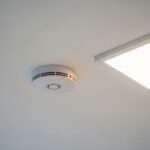
Knowing what we know about how smoke and CO move through the air, the consensus is to follow smoke detector rules when installing a combination device. A combined device should be installed on a ceiling or high on a wall. But there is one caveat: the device should not be installed in a corner or any other dead space that may inhibit CO accumulation.
When installing a combined smoke-CO detector, it is best to leave some distance between the unit and the nearest wall or ceiling. For example:
- Ceiling Mount – The unit should be kept at least 4-6 inches away from the wall.
- Wall Mount – The unit should be installed no closer to the ceiling than 12 inches.
Also note that it is important to read the manufacturer’s instructions prior to installation. A manufacturer might recommend different spacing. Also note that combination devices should not be installed in:
- Bathrooms (high humidity)
- Kitchens (false alarms)
- Drafty locations (e.g., near windows, vents, exhaust fans, etc.)
The technology behind both smoke and CEO detection has evolved significantly over the last several decades. So there is no problem following smoke detector rules. A modern CO detector should still work just fine mounted on the ceiling or high on a wall.
Adding Them to Your System
In closing, does your current home security system include integrated smoke and CO detectors? If not, consider adding them. They don’t cost much and they are easy to install. In return, they could save lives in the event of a fire or CO leak.